MARKET SNAPSHOT WITH PROJECTIONS
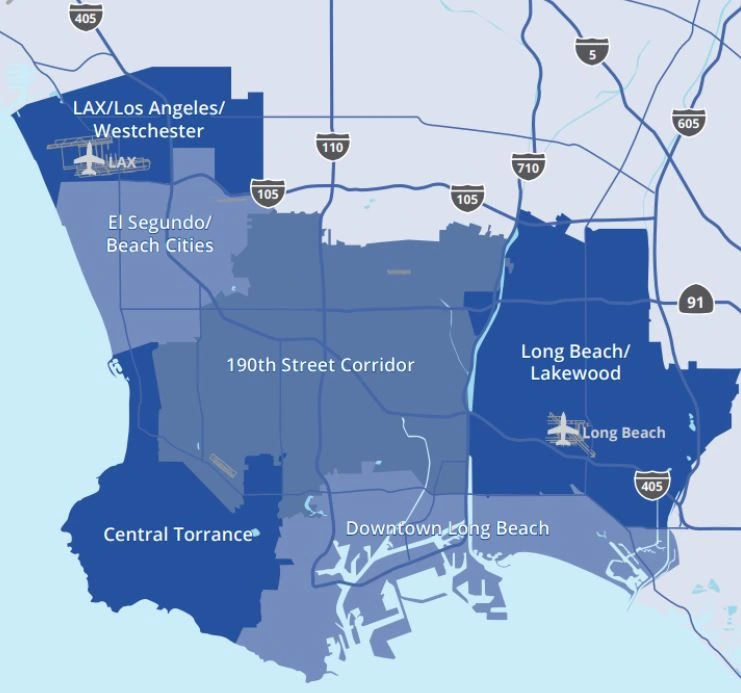
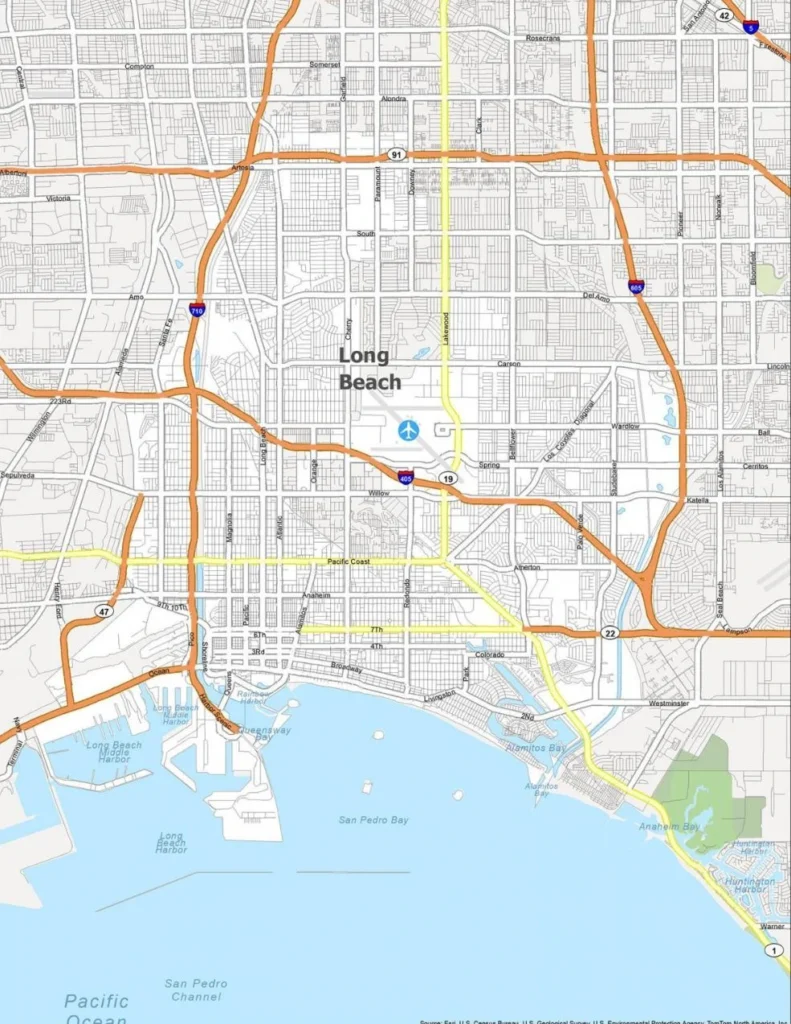
The Long Beach is three very different commercial economies and submarkets within one city.
Downtown: Office contraction, high vacancy, office-to-residential conversion, and a residential pipeline approaching 2,900 units among five major projects.
Airport/Douglas Park: Expansion driven by aerospace, defense, advanced manufacturing, and major new employment.
East Long Beach: A comparatively stable office market reinforced by strong demographics, CSULB, medical and professional users, and approximately 1,271 new residential units concentrated near 2nd & PCH.
These trends appear likely to continue through 2027 and into 2028: Downtown will keep adjusting to reduced traditional office demand while adding a substantially larger permanent residential population; Douglas Park will continue expanding around aerospace, defense and advanced manufacturing; East Long Beach should remain comparatively stable while the 2nd & PCH area undergoes a major residential transformation; and LA28 will increasingly influence waterfront activity, infrastructure preparation and visitor-oriented investment as the Games approach.
Downtown Office — Over 35% Vacancy
Downtown’s 35.3% commercial office vacancy reflects a fundamental reset in demand. Remote and hybrid work have reduced demand for conventional office space, particularly in large office buildings, while conversions and redevelopment are beginning to reduce portions of the older office inventory.
Oceangate captures both sides of the reset. The assessed value of 100 Oceangate fell from $54.3 million to $24.9 million, and in August 2026 the Port of Long Beach agreed to acquire the approximately 226,000-SF tower for $36 million as part of an effort to establish a maritime business hub Downtown.
LA28 — A Major Long Beach Event and Infrastructure Catalyst
Long Beach will be one of the principal venue cities for the 2028 Olympic and Paralympic Games, hosting 11 Olympic and seven Paralympic sporting events across seven venues. The Olympic program alone includes 161 ticketed events and 35 finals. The concentration of events along Downtown, Belmont Shore and Marine Stadium should bring substantial visitor activity while accelerating waterfront and public-infrastructure preparation ahead of 2028.
Downtown Office to Residential Conversion
Office-to-residential conversion remains one of the clearest ways Downtown’s commercial inventory is changing. The next wave is considerably larger than the conversions completed to date.
Landmark Square at 111 W. Ocean Blvd. is planned for conversion to approximately 391 apartments. The entitled 400 Oceangate project calls for conversion of the existing office tower to 200 units plus 75 additional units above the parking structure, for 275 units total. These projects alone would remove substantial conventional office space while adding 666 residences.
The result is a smaller Downtown office inventory and a larger residential population.
Downtown New Residential Coming & Underway
The current Downtown wave is now large enough to be viewed as a structural shift. Five major projects—Landmark Square (391 units), Alexan West End (600), the three-phase City Place/Mosaic plan (900), the former City Hall site at 321 W. Ocean (729), and 400 Oceangate (275)—represent approximately 2,895 residential units.
Alexan West End is nearing occupancy, while the first 272-unit phase of City Place/Mosaic is under construction with an expected 2028 opening. Other projects are approved, entitled or planned rather than committed to a specific 2028 delivery date. Taken together, the pipeline points to continued residential growth through 2028 and beyond, gradually shifting Downtown from a district dependent on thousands of daily office workers toward one with a much larger permanent residential population.
The housing market itself has become increasingly divided. Some longtime tenants remain in older apartments at comparatively low rents, while residents of newer developments can pay substantially more. A one-bedroom apartment might range from roughly $1,500 in older properties to $3,800 in newer buildings.
Douglas Park – Strong with Space, Defense and The Billion Dollar Bet
Douglas Park and the Long Beach Airport area tell a very different story.
Anduril & Palmer Luckey plan to occupy an approximately 1.1-million-SF campus consisting of six buildings under a 20-year lease. The project represents roughly $1 billion in investment and is expected to support approximately 5,500 jobs at full buildout. Two new parking structures with approximately 1,500 spaces each further illustrate the scale of the expansion.
Long Beach already supports approximately 6,500 advanced-manufacturing and aerospace jobs, many defense-related. Adding Anduril’s projected 5,500 jobs could expand that employment base toward 12,000 direct jobs, spanning defense, rockets, satellites, aircraft, 3D printing, robotics, and advanced manufacturing.
The company has been hiring at a rapid pace, reinforcing Douglas Park’s emergence as a major aerospace, defense, and advanced-manufacturing employment center.
NNN asking lease rates are approximately $1.80 per square foot per month.
Douglas Park Tenants – SF Occupied
Relativity Space 804K SF — rockets
Amazon Project Kuiper 505K SF — satellites
Divergent 430K SF — 3D and advanced manufacturing
Rocket Lab 144K SF — rockets/spacecraft
Voyager 140K SF — space systems
True Anomaly 91K SF — defense/space
Vast — space stations
JetZero — commercial aircraft
NovaWurks — satellites
ExLabs — space systems
Rebel Space — defense/space
Ampaire — electric aircraft
Nikon / Morf3D — advanced manufacturing
Ford — electric vehicle R&D
Eastside —Stable Office Market, Fast Growing Residential
The Eastside is the counterpoint to Downtown: a relatively high-occupancy, stable office market supported by neighborhood-serving professional and medical users, CSULB, and strong surrounding demographics.
Residential construction is adding another layer of demand near 2nd & PCH. The former Marketplace office site at 6615/6695 E. PCH is planned for 390 apartments; the former Congressional Place site at 6700 E. PCH is being redeveloped with approximately 281 apartments; and Onni Marina Shores is planned for 600 apartments.
Together, the three projects represent approximately 1,271 apartments. The redevelopment has also removed a meaningful amount of older commercial inventory: the 6615 and 6695 office buildings totaled 61,493 SF, the former 6700 PCH office building was approximately 73,076 SF, and the former Marina Shores shopping center contained approximately 67,930 SF—more than 200,000 SF of former office and retail space in total. The 45,955-SF office building at 6621 E. PCH remains.
Additionally, luxury student housing is planned at 5150 PCH which will remove 120,000 more square of Eastside office.